A Physiodemy tutor · free

Learn research methods by being questioned, not told.

Haytham helps physiotherapists and sports medicine clinicians turn a clinical problem into a question, build a search, screen records, extract data and judge risk of bias. It asks for your attempt first, tells you exactly what to improve, and only then shows one possible answer.

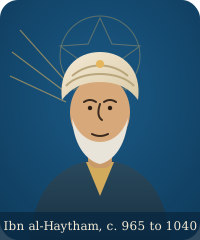
Stylised portrait of Ibn al-Haytham

"The seeker after truth does not put his faith in any mere consensus. He submits what he reads to reason and to proof."
Ibn al-Haytham, c. 965 to 1040

How it works

Three moves, every time

The same ladder in every section. It is slower than being given the answer, and it is how the method sticks.

1

You attempt

Haytham gives you the shape of the task, never the content. You write your question, your search blocks, your criteria or your judgement.

2

It responds to what you wrote

What is right, what is missing, what is wrong and why, in your own words. Then one question asking you to revise one thing.

3

Then one possible answer

After a real revision, or when you say you are stuck, you see one model version, labelled as such, to adapt to your own case.

What it refuses to do

Write your search, your question or your appraisal for you. Mark or grade anything. Predict what an examiner wants. Give clinical advice. Invent references or database counts. Discuss anything outside research methods.

What it adapts to

When you sign in you rate your confidence from 1 to 5. Beginners get smaller steps, fill-in-the-blank shapes and an earlier model answer. Confident learners get harder questions, direct disagreement and primary sources instead of explanations.

Can you just write my Ovid search for ACL rehab and return to sport?
I can help you improve what you write, not write it for you. Start with the question: "In adults with ..., does ... compared with ... improve ...?" Fill that in for your topic.
Blocks: ACL reconstruction, return to sport. Terms: "anterior cruciate ligament", ACL, "return to sport", "return to play". Heading: Anterior Cruciate Ligament Reconstruction/
Two sound blocks and the heading is right. You skipped the question itself, so write it first. Then the return-to-sport block has no subject heading yet. Which heading would you test?
Five sections

Start wherever you are in your review

Each section opens by asking for your attempt. When a section is complete, Haytham moves you to the next one.

1. From problem to question

Problem statement, choosing PICO, PEO, SPIDER, PCC, SPICE or PIRD, writing the question, the six tests.

2. Designs, review type and protocol

Which design answers which question, systematic versus scoping, PROSPERO and PRISMA-P.

3. Search blocks and the pilot test

Concept blocks, free text and subject headings, Ovid and PubMed syntax, reading the counts, seed papers, the search log.

3b. Screening and agreement

Criteria as a form, two blind screeners, conflicts, Cohen's kappa by hand, PRISMA 2020.

4. Extraction form and risk of bias

The ten-section form, piloting, priority rules, missing data, RoB 2, ROBINS-I, PEDro, GRADE in outline.

About

Who built this

Karthikeyan Muthumayandi

Karthikeyan Muthumayandi

Karthik is a musculoskeletal physiotherapist, researcher and educator with more than 25 years of experience across clinical practice, research and higher education. His career has taken him from New Delhi to Newcastle, then Kent, and now Dubai, where he directs postgraduate programmes in musculoskeletal physiotherapy and sport and exercise medicine, teaches evidence-based practice and research methods, and supervises systematic and scoping reviews from first question to final synthesis.

He has two specialities that he keeps side by side. The first is clinical: musculoskeletal physiotherapy and sport and exercise medicine. The second is digital: digital technology, the internet of things and learning technologies, and how they can be used in education and in rehabilitation. He founded Physiodemy to make rigorous, practical research-methods teaching free to clinicians anywhere, and he owns Blue Maya Physio, a group of physiotherapy clinics in London and Surrey.

Haytham grew out of his classroom. The questions it asks are the ones he asks students across a table: What is the problem? Who allocated the exposure? What did you skip? Why that tool and not the other one?

LinkedIn profile
Your data, plainly

What is recorded and why

What we store

Your name, an optional email, your confidence rating, everything you write and every reply, with the date and time.

Why

To study how the tutoring works and improve it. Patterns across many conversations tell us which questions help and which do not.

Who sees it

The Physiodemy teaching team only. Nothing is marked, nothing is shared with any institution or employer, and nothing is sold.

Your control

Email contact@physiodemy.com to have your record deleted at any time and it will be removed in full. The tutor can make mistakes: check facts in the Cochrane Handbook and your database's own help pages.

Bring your problem. Leave with a better question.

Two minutes to sign in. Free, and it will not write your work for you.

Start with Haytham